
Skip navigation
Text only
Chemical Laboratory Technician

Chemical Laboratory Technician

Program Code: CLTCampus: Seneca@York
Duration: 4 Semesters (2 Years)Start Dates: Summer, Fall, Winter
Start dates are subject to change
Credential Awarded: Ontario College Diploma

Program Description

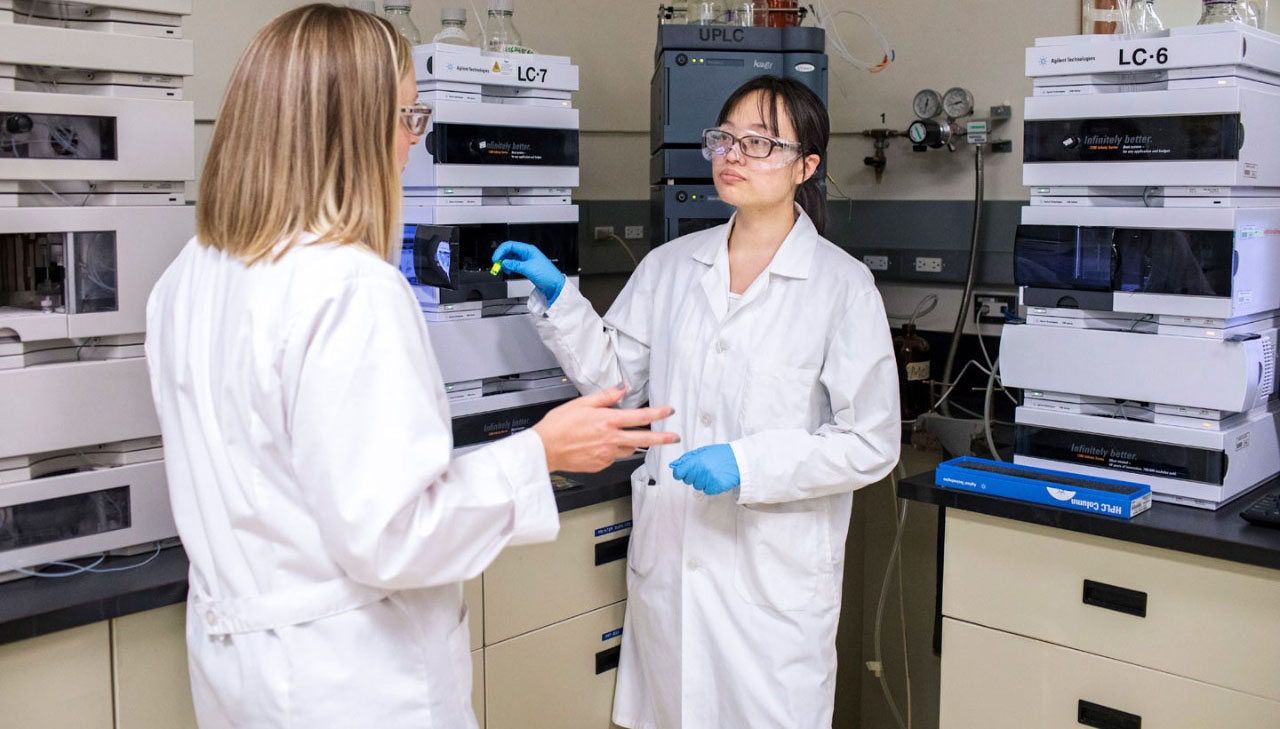
Learn the essential principles and techniques currently used in the biological and chemical sciences. In the CLT program, you’ll benefit from practical training. That means getting the hands-on experience necessary to perform assays and determinations with the required speed, precision, and accuracy required in a broad range of industries. You’ll also receive thorough training in the proper care and use of laboratory apparatus for wet and instrumental methods.

Program Learning Outcomes

This Seneca College program meets the system-wide standards for all Ontario College Credential programs as set by the Ministry of Training, Colleges and Universities.

As a graduate, you will be prepared to reliably demonstrate the following:

  • apply mathematical, physical, and chemical concepts to routine tasks such as the analysis and synthesis of chemical compounds and samples.
  • conduct basic manual quantitative and qualitative analyses accurately, using prescribed laboratory procedures.
  • prepare organic and inorganic compounds using standard synthetic and purification procedures.
  • perform routine statistical calculations to report the results of analyses.
  • perform instrumental chemical analysis and report the quantitative/qualitative results.
  • apply basic computer skills relevant to the chemical laboratory technology field.
  • perform established Quality Assurance and Quality Control procedures to ensure that processes remain within designated limits.
  • perform all assigned work in compliance with occupational health, safety, and environmental law, legislation, and regulations; established policies and procedures; and in accordance with ethical principles.
  • apply problem-solving skills to chemical laboratory technology.
  • use interpersonal and communication skills appropriate to the chemical laboratory technology environment.
  • develop a plan for continued professional growth.

Essential Employability Skills

Admission Requirements

Program Eligibility:

  • Ontario Secondary School Diploma with a majority of senior credits at the College Preparation (C), University Preparation (U) or University/College Preparation (M) level or Mature Student Status (age 19 or older)
  • Grade 12 English: ENG4(C) or ENG4(U)
  • Grade 11 Biology (C) or (U)
  • Grade 12 Chemistry (C)
  • Grade 12 Mathematics*: MCT4(C) Mathematics for College Technology (recommended grade 60% or over) or Grade 12 (U) Mathematics, MHF4(U) (Advanced Functions) or MCV4(U) (Calculus and Vectors)

* Seneca may also consider applicants with good grades in MAP4(C) (80% or over recommended) or MCR3(U) (70% or over). Students with grades lower than these recommended benchmarks and who test below the appropriate level in the skills assessment can expect to be placed into a preparatory mathematics course or will be counseled to enroll in the Applied Science and Technology Fundamentals Certificate Program.

Note: All applicants who are offered admission to programs in the Faculty of Applied Science and Engineering Technology will have an English and Mathematics skills assessment. The assessments are used for academic placement in English and Mathematics courses that are appropriate to the student’s skill level. In the event a preparatory course is required before enrolling in the standard semester one English or Mathematics, students will automatically be timetabled into the appropriate preparatory course.

The Importance of Learning Skills:

Student success in college requires well developed learning skills (such as being able to work independently, participate in a team, be well-organized, develop good work habits, and show initiative). These skills are as important as prior academic achievement. While it is expected that applicants would have developed these skills through previous education and life experiences, Seneca offers support to assist students with further development of these important skills.

Applicant Selection:

  • Applicant grades in pre-requisite subjects (or their equivalents) may be used as a basis for the selection of candidates.

Your Career

Work with government agencies, industry, university laboratories, and consulting firms on a range of projects from quality control to research and development. Your diploma in the Chemical Laboratory Technician program will prepare you to perform physical, chemical and microbiological analyses under the supervision of a technologist, chemist, biologist, or engineer.

Areas of Study

As a student of CLT, you’ll study a broad range of topics, including organic and analytical chemistry, biochemistry, industrial microbiology, pharmaceutical and instrumental methods.

Transfer to 3-Year Technology Programs

In the School of Biological Sciences and Applied Chemistry, the Technician (2-year) and Technologist (3-year) programs have a common first year, that is, semester one and semester two.

  • Students wishing to be considered for the three-year program in either BTR or CLP, may only apply to transfer after semester two or upon graduation from CLT.
  • In order to apply to transfer directly after semester two:
    • students must be in their current English level;
    • students must have a minimum G.P.A. of 2.5 in semester two while completing a minimum of three subjects.
  • In order to apply to transfer upon graduation:
    • students must have a semester four minimum G.P.A. of 3.0 OR a semester three and four average G.P.A. of 3.0 or greater.
  • Note that the following CLT subjects are not equivalent to three-year program subjects:
    • CHO372 is not equivalent to CHO353 or CHO373
    • MBG372 is not equivalent to MBG353
    • PHA372 is not equivalent to PHA333

Graduates of the 2-year Chemical Laboratory Technician program with a semester four minimum G.P.A. of 2.5 may apply to transfer to CHY semester four.

Diploma to Degree... and Beyond

Through transfer agreements and institution partnerships, graduates of this Seneca College program may be eligible for credit at the following post-secondary institution(s):

Toronto

University/CollegeDegrees Available
York University• Any relevant major

Ontario

University/CollegeDegrees Available
University of Western Ontario• Bachelor of Engineering Science

Canada

University/CollegeDegrees Available
Royal Roads University• Bachelor of Science in Environmental Science or Bachelor of Science in Environmental Management

Affiliations and Associations

  • Canadian Society of Microbiologists
  • Chemical Institute of Canada (CIC)

FAST TRACK into Semester Three

With existing post-secondary education in biology, biotechnology, chemistry or pharmaceutical sciences or technology disciplines, you may qualify to FAST TRACK your studies by entering directly into the second year of this program. The granting of credits beyond semester two is possible in exceptional cases. FAST TRACK entry may, at the discretion of the department, be offered to partially qualified candidates, in conjunction with requirements to complete additional subjects from semesters one or two.

School Guidelines

All students are required to follow guidelines, policies and procedures set down by the School of Biological Sciences and Applied Chemistry.

General Education

One of the general education subjects must be a literature subject (from any category), for which EAC150 is a pre-requisite. A general education subject (other than EAC), is a pre-requisite for SES391.

Curriculum

Semester 1 Subject Name Hrs/Wk
BIO173 Biology 6
CHM173 Chemistry 6
EAC150 College English 3
ICA001 Introduction to Computers and Applications 2
MTH173 Mathematics 5
SSA001 Science Survival 1
 
Semester 2 Subject Name Hrs/Wk
BIO273 Biology 6
CHM273 Chemistry 6
MTH273 Mathematics 5
PHY273 Physics 3
XXXXXX General Education Option 3
 
Semester 3 Subject Name Hrs/Wk
AIC372 Applied Inorganic Chemistry 3
CHO372 Chemistry - Organic 6
CPG453 Computer Applications 3
MBG372 Microbiology 5
SES391 Effective Technical Writing 3
XXXXXX General Education Option 3
 
Semester 4 Subject Name Hrs/Wk
BIC472 Biochemistry 6
IMB472 or
IPM472
Industrial Microbiology
Introduction to Pharmaceutical Manufacturing
5
5
ITM472 Instrumental Methods 6
IOC472 Analytical Chemistry 6
XXXXXX General Education Option 3

Contact Us

For more information, please visit our website at: biochem.senecac.on.ca
Program Student Advisor: Monica Russell
Telephone: (416) 491-5050 Ext. 33769
Email: Monica.Russell@senecac.on.ca
Program Chair: Iain McNab
Telephone: (416) 491-5050 Ext. 33410
Email: >Iain.McNab@senecac.on.ca
Admissions Advisors:
Domestic Admissions Advisor: Betrice Brangman
Telephone: (416) 491-5050 Ext. 22802
Email: betrice.brangman@senecac.on.ca
International Admissions Advisor: Aakashni Ram
Telephone: (416) 491-5050 Ext. 22805
Email: Aakashni.Ram@senecac.on.ca
Registration & Records Advisor: Diane Duerden
Telephone: (416) 491-5050 Ext. 33006
Email: diane.duerden@senecac.on.ca